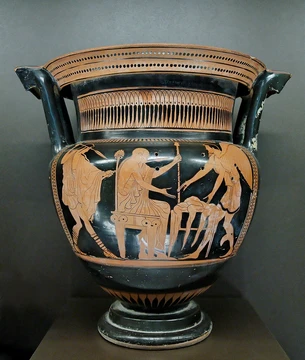
Achilles and Patroclus
Their bond is a cornerstone of the Trojan War narrative.

Achilles and Patroclus are central figures in the stories of the Trojan War, most famously depicted in Homer's Iliad. Their relationship is a key element of the epic, characterized by deep emotional bonds and mutual dependence, though its exact nature has been debated from antiquity to the present.
- field
- Greek mythology and literature
- known_for
- Central relationship in the Iliad; subject of ancient and modern debate over its nature
Lore & Background
In the Iliad, Achilles and Patroclus quarter together in a tent near the Greek ships. When King Agamemnon sends an envoy to persuade Achilles to fight, the diplomats find Achilles playing the lyre and singing alone with Patroclus. After the embassy fails, Achilles asks Patroclus to prepare a bed for one envoy, and later Achilles sleeps next to Diomede (a woman) while Patroclus sleeps next to Iphis. Nestor later advises Patroclus to counsel Achilles or, failing that, to don Achilles' armor to deceive the Trojans. Patroclus weeps at Greek casualties and confronts Achilles, who agrees to let him use the armor but warns him only to drive the Trojans from the ships. Patroclus dons the armor, kills Sarpedon, but is then killed by Hector. Achilles' grief is profound: he tears his hair, smears himself with ash, embraces Patroclus' body until dawn, and fasts. He returns to battle solely to avenge Patroclus, despite knowing it will cost him his life. After killing Hector, Achilles defiles the corpse and promises to remember Patroclus forever. Patroclus' ghost appears to Achilles in a dream, asking that their bones be mixed in the same urn; Achilles arranges this. In the Odyssey, the ghosts of Achilles, Patroclus, and others meet Agamemnon's ghost, who confirms their bones were mixed in a golden vase, and notes that after Patroclus' death, Achilles loved Antilochus most among his comrades, whose bones were placed in the same vase but kept separate.
Reader's Guide
The relationship between Achilles and Patroclus is a key element of the Trojan War stories, but its exact nature has been disputed since the Classical period. Homer never explicitly casts them as lovers, but they were frequently interpreted as such by ancient writers like Aeschylus, Aeschines, and Plato. Others, such as Xenophon, argued it was an intense non-sexual friendship. Medieval scholars largely characterized it as non-sexual, sometimes suppressing homoerotic aspects. Since the 19th century, the debate has resumed, with some classicists and queer studies scholars arguing for a homosexual or homoerotic reading, while others maintain there is no textual evidence for a sexual relationship. The Iliad describes Achilles' grief for Patroclus in terms similar to Andromache's grief for Hector, and Achilles adopts a female role of lamentation. The bond is an archetypal male comradeship, paralleled by Damon and Pythias, Orestes and Pylades, and Harmodius and Aristogeiton. The Oxford Classical Dictionary notes that Homer does not portray them as lovers, though some Classical Athenians thought he implied as much.
Did You Know?
- In the Iliad, Achilles and Patroclus are never explicitly described as lovers, but ancient writers like Aeschylus and Plato interpreted them as such.
- Patroclus' ghost asks Achilles to have their bones mixed in the same funerary urn, which Achilles arranges.
- After Patroclus' death, Achilles loved Antilochus most among his comrades, according to Agamemnon in the Odyssey.
- Achilles' grief for Patroclus is described in terms similar to Andromache's grief for Hector, and he adopts a female role of lamentation.
The Texture of Their Bond in Homer's Iliad
Homer paints Achilles as a man of two registers: tender and devoted toward Patroclus, yet callous and arrogant toward everyone else. The two men share a tent near the Greek fleet, and in one of the Iliad's most intimate scenes, Odysseus and Ajax stumble upon Achilles playing the lyre while Patroclus sits beside him; both men spring to their feet in startled surprise at the intrusion. When the diplomatic embassy fails, Achilles assigns Patroclus to prepare a guest bed in the outer section of their shared space, and that night the two sleep in the inner part of the tent, each beside a different companion. Nestor, in Book XI, reminds Patroclus that although Achilles is the nobler warrior, Patroclus is his elder and should counsel him wisely. This dynamic—Achilles as the brilliant but impulsive hero, Patroclus as the steadier voice—frames their entire relationship within the epic.
The Weight of Loss
When Antilochus brings the news of Patroclus' death, the Iliad's most unbreakable warrior collapses. Antilochus grips Achilles' hand, terrified that the hero will take his own life. Achilles tears at his hair, smears himself with ash, and in Book XIX he embraces Patroclus' corpse until dawn, refusing all food. His grief is not merely personal; he laments that he had once imagined a future in which, after his own fated death in battle, Patroclus would live on to carry Achilles' son home and show him his inheritance. That imagined future—Patroclus as the surviving guardian of his lineage—now shatters into nothing. The loss reorders everything Achilles values. The man who had refused Agamemnon's authority, who had withdrawn from the war out of wounded pride, is now consumed by a single, all-consuming purpose: to make the Trojans pay for what they have taken from him.
Vengeance and the Shared Urn
Patroclus' death ignites a rage that drives Achilles back into the war with one goal: killing Hector. He tells his mother Thetis that he does not wish to live once the vengeance is complete. In Book XXI he even fights the river god Scamander in his desperate push toward Hector, and in Book XXII he finally defeats the Trojan champion. Achilles strips Hector's armor, delivers a speech vowing to remember Patroclus for the rest of his life and into the underworld, and then drags Hector's body behind his chariot. But the epic does not end in pure fury. In Book XXIII, Patroclus' ghost visits Achilles in a dream, mourning their separation and asking that their bones and ashes be mixed in the same funerary urn. As Achilles reaches to embrace the apparition, the dream dissolves. The next day he arranges a grand funeral and instructs Agamemnon and the other kings to bury his own ashes alongside Patroclus in the shared vessel.
A Relationship in Perpetual Debate
Homer never explicitly labels Achilles and Patroclus as sexual lovers, yet the question of what their bond means has generated centuries of argument. In the classical period, writers such as Aeschylus, Aeschines, and Plato depicted them as lovers, while Xenophon, in his Symposium, insisted the relationship was an intense but non-sexual friendship. Ancient thinkers also wrestled with where the pair fit within the broader Greek institution of pederasty. Medieval scholars largely settled on the friendship reading, sometimes downplaying or suppressing passages in Achilles' behavior that could be read as homoerotic. Since the nineteenth century, the debate has flared again: some classicists and queer-studies scholars argue the Iliad encodes a homosexual or latently homosexual relationship implicitly, while other historians and classicists counter that no explicit textual evidence supports a sexual reading and that the claim of repressed homosexuality is unfalsifiable. The relationship remains, in effect, a mirror in which each era sees its own assumptions about love, desire, and friendship.
Frequently Asked Questions
Who are Achilles and Patroclus?
They are two Greek heroes who appear as close companions in Homer's Iliad during the Trojan War. Achilles is the mightiest warrior on the Achaean side, while Patroclus is his trusted friend and fellow fighter among the Myrmidons.
What is the nature of Achilles and Patroclus's relationship?
The Iliad portrays their bond as one of the most intense emotional ties in the epic, defined by deep loyalty, shared grief, and mutual dependence. Ancient and modern readers have long debated whether the text presents them as close friends, lovers, or something else, and no single reading has been universally settled.
How does Patroclus die in the story?
After Achilles withdraws from the fighting, Patroclus borrows his armor and leads the Myrmidons into battle, where he is ultimately slain by the Trojan prince Hector. His death serves as the pivotal catalyst that draws Achilles back to the front lines.
What does Achilles do after Patroclus's death?
Consumed by rage and sorrow, Achilles re-enters combat and kills a great number of Trojans before slaying Hector in single combat. He then drags Hector's corpse behind his chariot as an act of vengeance, though he eventually relents and returns the body to Priam in the epic's closing books.
Why are Achilles and Patroclus important to the Iliad?
Their bond forms the emotional engine of the poem, driving the central conflict and giving the narrative its themes of loss, honor, and the human cost of war. Without their relationship, the key turning points—Achilles' withdrawal, Patroclus's death, and the final confrontation with Hector—would not exist.
More in Mythological duos 1-24
Spotted an error? Know more?
This is a living reference — every entry is fact-audited, and reader corrections feed straight into our audit queue. Suggest an edit · See this site's audit record