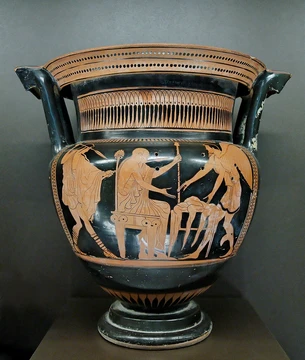
Boreads
Twin sons of Boreas, Argonauts who drove off the harpies.

In Greek mythology, the Boreads are the twin "wind brothers" Zetes (sometimes spelled Zethes) and Calaïs. Their name, from the Ancient Greek *Boreádai*, means "sons of the north wind." They came from Thrace, the homeland of their father Boreas, the North Wind. The brothers were Argonauts and were key in saving Phineus from the Harpies.
Zetes and Calaïs were known for their supernatural speed and ability to fly, often depicted with wings on their feet or shoulders. As sons of the north wind, they had gifts that rivaled the wind itself. Their wings are described in some sources as dark or dusky, but the image of golden scales is not part of the standard mythos.
During the rescue of Phineus, they drove off the Harpies but did not kill them, at the request of the rainbow goddess Iris, who promised Phineus would be left alone. In thanks, Phineus told the Argonauts how to pass the Symplegades. The Boreads were turned back by Iris at the Strophades, whose name means "Islands of Turning."
According to Phanocles, the singer Orpheus loved Calais; Orpheus would sing of his desire for Calais and gaze at him, angering the women of Thrace, who eventually killed Orpheus as he wandered thinking of Calais. The Boreads’ death was caused by Heracles on Tenos, as revenge for convincing the Argonauts to leave him behind while he searched for Hylas in Mysia. Other sources say they died chasing the Harpies, fated to perish if they failed to catch them; in some versions, the Harpies fall into the sea from exhaustion, and the pursuers fall too. Calais traditionally founded Cales in Campania.
The Boreads were twin sons of Boreas and Oreithyia, daughter of King Erechtheus of Athens. They were brothers of Chione and Cleopatra, wife of Phineus, king of Thrace. In a rare variant by Tzetzes, the blind old man Phineus had two daughters, Eraseia and Harpyreia, who lived lazily and fell into poverty and famine; they were snatched away by Zetes and Calais and never seen again. In one version, Zetes married Aëdon, who suspected he was cheating with a hamadryad nymph and that their son Aëtylus was covering for him. In anger, she killed the boy after
- born
- Thrace
- field
- Greek mythology
- nationality
- Thracian
- known_for
- Argonauts, rescue of Phineus from the harpies, sons of Boreas
Lore & Background
Zetes and Calais were credited with supernatural speed and the ability to fly, often depicted with wings on their feet or shoulders. As sons of the north wind, they were supernaturally gifted in different ways depending on the version of the myth—either being as fast as the wind or able to fly. Their wings are sometimes described as dark or dusky, but the detail of golden scales is not found in canonical sources. Contrary to some later interpretations, Ovid's *Metamorphoses* does not describe them sprouting wings in adulthood; their divine nature was evident from birth or youth.
They succeeded in driving the harpies away from Phineus but did not kill them, at a request from the goddess of the rainbow, Iris, who promised that Phineus would be left alone.
Reader's Guide
The Boreads, Zetes and Calais, are significant in Greek mythology as the twin sons of Boreas, the North wind, and as Argonauts who played a crucial role in the rescue of Phineus from the harpies. Their story illustrates the fluidity of myth, with varying accounts of their abilities—whether they flew with wings on their feet or backs, or were simply as fast as the wind. Their encounter with Iris at the Strophades, which gave those islands their name, highlights the interplay between mortal heroes and divine intervention. The tradition that Calais was loved by Orpheus adds a tragic dimension, linking the Boreads to the famous singer's death. Their own deaths are recorded in conflicting versions: either killed by Heracles or perishing in pursuit of the harpies. The founding of Cales in Campania by Calais ties them to historical geography. Overall, the Boreads exemplify the heroic and supernatural elements common in Greek mythology, serving as both helpers and figures of complex fate.
Did You Know?
- The Boreads had dusky wings which gleamed with golden scales.
- They were turned back by Iris at the Strophades, whose name means 'Islands of Turning'.
- Calais was loved by the singer Orpheus, according to Phanocles.
- Their death was said to be caused by Heracles in Tenos for convincing the Argonauts to leave him behind.
Origins, Lineage, and the Gift of Flight
The Boreads—Zetes and Calais—were twin sons born in Thrace to Boreas, the personification of the north wind, and Oreithyia, daughter of Athens' King Erechtheus. Their siblings included Chione and Cleopatra, the latter who would become wife to Phineus, king of Thrace. As children of a divine wind, the brothers possessed supernatural abilities that varied across tellings: some accounts describe them as swift as a gale, while others grant them actual flight. In Ovid's Metamorphoses, their divine nature manifested in adulthood when wings sprouted along their backs. Their most celebrated physical trait was their extraordinarily fine, graceful hair, which in certain traditions was itself the source of their aerial power. The two were famously vain about their locks, each boasting that his curls were the longest, and this very pride was said to lift them skyward. When wings did appear, they were described as dusky in color, shimmering with golden scales—a striking contrast to the delicate, almost ethereal quality of their hair.
The Argonauts and the Harpies
As members of the Argonautic crew, Zetes and Calais played a pivotal role in one of the expedition's most dramatic episodes: the liberation of Phineus, their uncle, from the torment of the harpies. The brothers pursued the winged monsters and succeeded in driving them off, yet they stopped short of killing them. This restraint came at the behest of Iris, the goddess of the rainbow, who intervened and assured Phineus that the harpies would never trouble him again. Grateful for his deliverance, Phineus rewarded the Argonauts with crucial navigational intelligence—specifically, how to safely navigate past the Symplegades, the clashing rocks. In a further twist, the Boreads themselves were turned back by Iris at the Strophades, a cluster of islands whose very name, meaning 'Islands of Turning,' preserves the memory of this divine redirection. The episode cemented the brothers' reputation as protectors whose power was checked not by the monsters they opposed but by the gods who governed the boundaries of their mission.
Fated Deaths and Divine Retribution
The Boreads met their end in several conflicting traditions, each underscoring the tragic trajectory of their myth. In one prominent account, their death was the doing of Heracles on the island of Tenos. The hero struck them down in vengeance for an earlier slight: during the search for Hylas in Mysia, the Boreads had persuaded the rest of the Argonauts to abandon Heracles, leaving him behind. This act of betrayal cost them their lives when the god-like hero finally caught up with them. A separate tradition frames their death as an inescapable fate tied to their pursuit of the harpies. In this version, the brothers were doomed to perish should they fail to catch their quarry. The chase ended not in triumph but in mutual exhaustion: the harpies, spent from the long flight, dropped into the sea, and the Boreads, following them, fell as well. Whether by the hand of a vengeful hero or by the inexorable logic of a divine curse, the wind-brothers' story closes with a fall from the sky they had once commanded with such pride.
Love, Jealousy, and Lasting Legacy
Beyond their heroic deeds, the Boreads are entangled in some of Greek myth's most poignant love stories. According to the poet Phanocles, Calais was the object of Orpheus's passionate desire. The legendary singer would vocalize his longing for the wind-brother and gaze upon him with such intensity that the women of Thrace grew furious with jealousy. In one telling, it was these enraged Thracian women who killed Orpheus while he wandered the countryside lost in thoughts of Calais. Zetes, meanwhile, is linked in one version to a domestic tragedy with his wife Aëdon, who suspected him of an affair with a hamadryad nymph and believed their son Aëtylus was complicit in covering it up. In a fit of rage, Aëdon killed her son upon his return from a hunt. Moved by pity, Aphrodite transformed the grieving mother into a nightingale whose song still mourns her child—though scholars note this may be a conflation with a different figure, Zethus. Calais also left a lasting mark on the Italian landscape, traditionally credited with founding the city of Cales in Campania.
Frequently Asked Questions
Who are the Boreads?
The Boreads are the twin brothers Zetes and Calais, demigod sons of Boreas, the North Wind, born in Thrace. Their shared name simply means 'sons of the north wind' in Ancient Greek.
What powers do the Boreads possess?
Both brothers have superhuman speed and the ability to fly, usually depicted with wings sprouting from their feet or shoulders. As offspring of the North Wind, their swiftness is described as rivaling the wind itself, and some sources note their wings appear dark or dusky.
What role did the Boreads play among the Argonauts?
Zetes and Calais sailed with Jason's crew on the Argo and proved essential during the voyage. Their standout contribution was rescuing the blind seer Phineus by chasing the Harpies away from him.
How did Zetes and Calais defeat the Harpies?
The Harpies kept stripping Phineus of his food, but the twins used their wind-born speed and flight to pursue the creatures through the air. Their natural advantage as children of the North Wind let them outpace the Harpies and drive them off for good.
Why are the Boreads significant in Greek myth?
They bridge the gap between elemental deities and the heroic world, showing how Boreas's raw force operates through mortal-scale brothers. Their story also anchors the Argonaut narrative by giving Phineus his salvation and highlighting the theme of wind as a divine gift.
More in Mythological duos 1-24
Spotted an error? Know more?
This is a living reference — every entry is fact-audited, and reader corrections feed straight into our audit queue. Suggest an edit · See this site's audit record