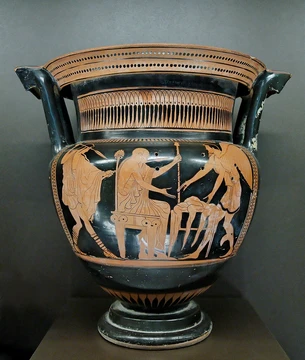
Aloadae
Giant brothers who warred with the gods and founded cities.

In Greek mythology, the Aloadae (or Aloads) were Otus (or Otos) and Ephialtes, Thessalian sons of Princess Iphimedia, wife of Aloeus, by Poseidon. They were strong and aggressive giants, growing nine cubits in width and nine fathoms in height each year, and were nine cubits broad and nine fathoms tall at age nine, outshone in beauty only by Orion. They are known for their failed war against the Olympian gods, their kidnapping of Ares, and their eventual deaths on Naxos.
- born
- Thessaly (mythological)
- died
- Naxos (mythological)
- field
- Greek mythology
- nationality
- Thessalian (mythological)
- known_for
- Storming Mount Olympus, kidnapping Ares, founding cities, worshiping the Muses
Lore & Background
The Aloadae, Otus and Ephialtes, planned to storm Mount Olympus and gain Artemis for Otus and Hera for Ephialtes. Their scheme involved piling Mounts Olympus, Ossa, and Pelion atop one another. According to Homer, Apollo killed them before they had beards, and they were bound in the Underworld by snakes. In another version, they kidnapped Ares and held him in a bronze jar for thirteen months, until Hermes rescued him after being alerted by their stepmother Eriboea. They died on Naxos when Artemis transformed into a doe and jumped between them; they threw their spears and killed each other simultaneously. Alternative accounts say Apollo killed them during their mountain assault, or that Otus attempted to rape Artemis, prompting Apollo to send the deer. Their sisters Elate and Platanus mourned so intensely they were turned into a fir and a plane tree, respectively.
Reader's Guide
The Aloadae represent a recurring theme in Greek mythology: mortal or semi-divine beings who challenge the gods and suffer dire consequences. Their story appears in multiple ancient sources, including Homer, Virgil, and Ovid, with variations in details such as the order of mountains piled or the cause of their deaths. Beyond their conflict with the gods, they are also depicted as civilizing heroes: according to Pausanias, they were the first to worship the Muses on Mount Helicon, honoring only three Muses—Melete, Mneme, and Aoede. They founded cities including Naxos, Boeotian Ascra, and Aloïum in Thessaly, and taught culture to humanity. Diodorus recounts a tradition where they were sent to rescue their mother and sister from Thracians, then ruled Naxos before killing each other in a dispute. Their legacy includes the ichnogenus Otozoum, named after Otus, and Ephialtes appears as a giant in Dante's Inferno, chained for challenging Jupiter.
Did You Know?
- The Aloadae grew nine cubits in width and nine fathoms in height each year, and were nine cubits broad and nine fathoms tall at age nine.
- They kidnapped Ares and held him in a bronze jar for thirteen months.
- Their sisters Elate and Platanus were turned into a fir tree and a plane tree after mourning their deaths.
- The ichnogenus Otozoum, a sauropodomorph dinosaur, was named after Otus.
Origins and the Making of Giants
The Aloadae—Otus and Ephialtes—stand among the most striking figures in Greek myth, their very names carrying weight. Otus derives from a word meaning "insatiate," while Ephialtes translates to "nightmare," foreshadowing the dread they would inspire. These Thessalian brothers were the offspring of Princess Iphimedia, wife of the mortal Aloeus, and the sea god Poseidon. The union was no ordinary affair: Iphimedia lured the god to the shore, where she played in the surf or scooped seawater into her bosom, thereby conceiving. Though Poseidon sired them, it was Aloeus who lent them their shared patronymic, the Aloadae. The brothers were born with extraordinary physical potential, growing nine fingers in height each month. By the age of nine they stood nine fathoms tall, and their beauty was surpassed only by that of the hunter Orion. Their sister Pancratis was likewise celebrated for her striking appearance, completing a family defined by raw, overwhelming presence.
The Assault on Olympus
The Aloadae's ambition knew no ceiling. Driven by desire for the divine—Artemis for Otus, Hera for Ephialtes—they devised a scheme to storm Mount Olympus itself. Their method was architectural: they intended to stack mountains one upon another, creating a tower from which they could reach the gods. Homer, Virgil, and Ovid all reference this plan, though the exact arrangement of peaks varies among sources. Typically Olympus forms the base, with Ossa and Pelion stacked above in some order. The episode of Ares's capture adds a darker chapter. The brothers seized the god of war and imprisoned him in a bronze storage jar for thirteen months—an entire lunar year. Only the intervention of Eriboea, their stepmother, who whispered the secret to Hermes, freed Ares and ended what might have been the permanent end of his warlike appetite. Homer records that Apollo struck them down before they had even grown beards, a detail underscoring their youth and the swiftness of their undoing.
Death on Naxos and the Grief of Sisters
The brothers' end came on the island of Naxos, and the myths offer several versions of how. In the most vivid account, Artemis transformed herself into a doe and leapt directly between the two giants. Refusing to let the creature escape, they hurled their spears at her—and in that same instant, the weapons struck each other, killing both simultaneously. An alternative tradition has Apollo dispatching them during their failed ascent of the mountain tower, while yet another holds that Otus attempted to assault Artemis, prompting Apollo to send the deer as a deadly distraction. Whatever the mechanism, the aftermath was equally tragic. Their sisters Elate and Platanus grieved so profoundly that the gods transformed them into trees—a fir and a plane, respectively—so their sorrow would live on in living wood. Diodorus offers a more grounded variant: the brothers had been sent by Aloeus to recover their mother and sister from Thracian captors, settled as rulers on Naxos after defeating their enemies, but ultimately slew one another in a quarrel. The Naxians thereafter honored them as local heroes.
Civilization-Bearers and Echoes Through the Ages
Beyond their violent myth, the Aloadae occupy a remarkable place as cultural founders. Pausanias records that they were regarded as the very first humans to worship the Muses on Mount Helicon, consecrating the sacred peak to the goddesses—though they honored only three: Melete, Mneme, and Aoede. They are credited with founding the cities of Naxos and Boeotian Ascra, as well as the Thessalian town of Aloïum, and with teaching civilization and culture to humankind. Their name "Ephialtes" also entered the Greek lexicon as the word for nightmare, and the brother was sometimes identified as the daimon of such terrors. Their shadow stretches into later literature: in Dante's Inferno, Ephialtes appears as one of six giants chained in the abyss separating the circles of Fraud and Cocytus, punished eternally for his challenge to Jupiter. Even modern paleontology bears their imprint, with the sauropodomorph ichnogenus Otozoum named in honor of Otus, linking the ancient giants to the fossil record.
Frequently Asked Questions
Who are the Aloadae?
The Aloadae are the twin giant brothers Otus and Ephialtes, born in Thessaly to Poseidon and the princess Iphimedia, wife of Aloeus. They rank among the most physically imposing figures in Greek myth.
What were the Aloadae's powers or defining traits?
Their most remarkable trait was their supernatural growth rate: each year they gained nine cubits of width and nine fathoms of height, making them colossal by the age of nine. Among the giants, only Orion surpassed them in physical beauty.
What did the Aloadae do to Ares?
They seized the god of war, sealed him inside a bronze vessel, and kept him imprisoned for thirteen months. This act of defiance was a central episode in their broader campaign against the Olympian gods.
How did the Aloadae's story end?
Their legend concludes with their deaths on the island of Naxos, following a failed attempt to storm Mount Olympus. Despite their tremendous size and strength, they were ultimately slain.
Why are the Aloadae significant in Greek mythology?
They embody the theme of mortal hubris against divine order, having waged open war on the Olympians. They are also credited with founding cities and showing devotion to the Muses, giving them a broader cultural footprint beyond their violent deeds.
More in Mythological duos 1-24
Spotted an error? Know more?
This is a living reference — every entry is fact-audited, and reader corrections feed straight into our audit queue. Suggest an edit · See this site's audit record