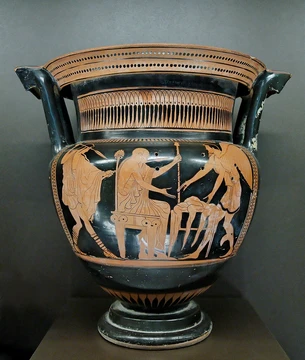
Ashinazuchi and Tenazuchi
Earth deities who lost seven daughters to Yamata no Orochi.

Ashinazuchi and Tenazuchi are a married pair of earth kami from the Kojiki. Their names translate to “foot-earth” and “hand-earth.” They are the parents of Kushinadahime, but originally had eight daughters; the other seven were eaten by the serpent Yamata no Orochi.
- names
- Ashinazuchi (足名椎) and Tenazuchi (手名椎)
- type
- Earth deities (kami)
- nationality
- Japanese
- known_for
- Parents of Kushinadahime; encounter with Susanoo
- source
- Kojiki
Lore & Background
Ashinazuchi and Tenazuchi appear as an old man and woman. Sometimes the names are switched, and Tenazuchi is the father. When Susanoo was exiled, he found Ashinazuchi and Tenazuchi weeping and consoling their daughter, Kushinadahime, by the Hii River. When he asked what was wrong they introduced themselves and explained that Yamata no Orochi was about to come for Kushinadahime, as it had done for their other seven daughters.
Reader's Guide
Ashinazuchi and Tenazuchi are significant in Japanese mythology as the grieving parents whose plight sets the stage for Susanoo's defeat of Yamata no Orochi. Their story illustrates the cycle of sacrifice and rescue central to the Kojiki narrative. By following Susanoo's instructions to build an eight-gated fence with tubs of saké, they enable the monster's incapacitation and the eventual discovery of the sword Kusanagi-no-Tsurugi. Their legacy is tied to the protection of their last daughter and the origin of a legendary imperial regalia. The ambiguity in their names—sometimes swapped—and Tenazuchi's later association with Gendayū as a protector on the Tōkaidō road show how these figures persist in folk tradition beyond their original myth.
Did You Know?
- Their names mean 'foot-earth' and 'hand-earth' respectively.
- They originally had eight daughters before seven were devoured by Yamata no Orochi.
- Sometimes the names are switched, and Tenazuchi is the father.
Identity & the Language of Earth
Ashinazuchi and Tenazuchi are a married pair of earth deities recorded in the Kojiki, and their very names—translating to "foot-earth" and "hand-earth"—anchor them in the physical, terrestrial realm rather than the celestial sphere. They are consistently portrayed as an elderly couple, an old man and an old woman, whose ancient, soil-bound presence contrasts with the more luminous kami who dominate much of the Japanese pantheon. A notable feature of their tradition is the occasional swapping of parental roles: in some tellings Tenazuchi is the father rather than the mother. In those alternate versions, Tenazuchi is additionally identified as Gendayū, a figure who guards travelers along the Tōkaidō road, one of Japan's most historically vital highways. This dual identity shows how a primordial earth deity can accumulate a localized, devotional role over time. Their status as the parents of Kushinadahime further embeds them in the divine genealogy, linking the ground beneath one's feet to the broader web of kami and to the most celebrated hero-slaying episode in Japanese myth.
Seven Years of Grief by the Hii River
Before the famous rescue of Kushinadahime, Ashinazuchi and Tenazuchi endured a devastating, repeating cycle of loss that the Kojiki renders with quiet, devastating specificity. The couple originally bore eight daughters, but Yamata no Orochi—the great serpent—claimed one child each year, swallowing her whole. Over seven years, seven of their daughters were devoured, leaving only the youngest as their sole remaining offspring. The text captures the couple in a moment of raw parental sorrow: they are found weeping by the banks of the Hii River, consoling their last daughter as they await the serpent's inevitable return. Their grief is not abstract or symbolic; it is the accumulated weight of seven empty places at the hearth and the terror of knowing the eighth year is already counting down. This image of an elderly couple mourning the systematic destruction of their family gives the myth a deeply human emotional core. Their weeping becomes the catalyst that draws the exiled god Susanoo's attention and sets the entire slaying of the Orochi in motion, transforming private sorrow into a mythic turning point.
The Eight-Gated Fence and the Sword in the Tail
When Susanoo learned of the Orochi's annual hunger and the imminent threat to Kushinadahime, his response was swift and resourceful. He transformed his daughter into a hair comb and tucked it into his own hair, removing her from the serpent's reach entirely. Yet the plan demanded the couple's active, physical labor. Susanoo instructed Ashinazuchi and Tenazuchi to construct a fence with eight gates and to place a large tub of saké behind each one. The elderly earth deities carried out this task, their hands shaping the very ground from which they drew their names. When Yamata no Orochi arrived, its multiple heads drank from all eight tubs simultaneously, and the potent alcohol sent the massive creature into a deep slumber. Seizing the moment, Susanoo cut the beast apart, and within its tail he discovered the legendary sword Kusanagi-no-Tsurugi. The couple's work—building the fence, preparing the saké—made them essential co-architects of one of Japanese mythology's most pivotal victories, their earthbound hands literally constructing the stage on which the god's heroism was performed.
A Guardian on the Tōkaidō and Beyond
Though they appear in only a single episode of the Kojiki, Ashinazuchi and Tenazuchi occupy a remarkable and layered position in Japanese mythological memory. As earth deities whose names literally mean "foot-earth" and "hand-earth," they embody the grounded, physical world in contrast to the celestial kami who populate much of the pantheon. Their story has also generated interpretive variation across traditions: in some tellings the parental roles are reversed, with Tenazuchi taking the father's place, and in those versions the figure is further identified as Gendayū, a protector of travelers on the Tōkaidō road. This layering suggests that over centuries the couple's identity absorbed local devotional practices, transforming from a pair of weeping parents in a foundational myth into a recognizable guardian spirit for those who walked one of Japan's great highways. Their legacy is thus twofold: they anchor the Kojiki's most famous monster-slaying narrative with an emotionally resonant domestic tragedy, and they persist in folk tradition as a quiet, protective presence on the road—an echo of the earth itself watching over those who cross it.
Frequently Asked Questions
Who are Ashinazuchi and Tenazuchi?
They are a married pair of earth kami in Japanese mythology, recorded in the Kojiki. Their names translate roughly to "foot-earth" and "hand-earth," identifying them as personifications of the ground itself.
What is Ashinazuchi and Tenazuchi's role in the Kojiki?
They function as the divine parents of Kushinadahime, the earth goddess who later becomes Amaterasu's consort. Their brief appearance provides the lineage that links the earth kami to the sun goddess's marriage.
What happened to Ashinazuchi and Tenazuchi's daughters?
The couple originally bore eight daughters, but the eight-headed serpent Yamata no Orochi devoured seven of them one by one. Only their youngest child, Kushinadahime, survived the monster's attacks.
How do Ashinazuchi and Tenazuchi interact with Susanoo?
Susanoo encounters the two earth kami while traveling toward the land of the earth goddess, and they are the ones who present their surviving daughter Kushinadahime to him as a prospective bride. This exchange sets off the chain of events that leads to Susanoo's conflict with Amaterasu.
Why are Ashinazuchi and Tenazuchi important to the broader Japanese myth?
They anchor the earth-divine lineage that makes the celestial union between the earth and the sun possible. Without their parentage, Kushinadahime's role as Amaterasu's divine wife would lack its mythological foundation.
More in Mythological duos 1-24
Spotted an error? Know more?
This is a living reference — every entry is fact-audited, and reader corrections feed straight into our audit queue. Suggest an edit · See this site's audit record